There was a time when people I rode with thought I was auditioning to be a crash dummy for bicycle helmet testing.
I broke no less than four bicycle helmets in my 30s.
The fact I walked away from several relatively mundane crashes — although I needed an ambulance ride and a trip to the emergency room after one spectacular downhill crash when I struck a loose dog that charged me when I was going 42 mph — caught the attention of Rex Osborn when he was a Manteca Police Department community service officer.
He enlisted me to join him in a bicycle safety assembly blitz of Manteca elementary schools.
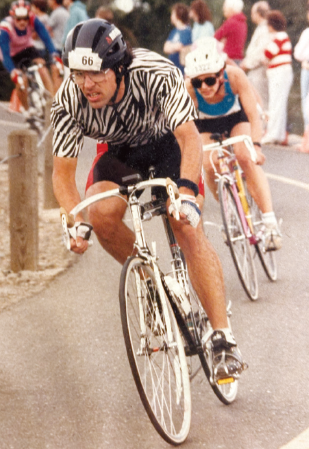
I came dressed in cycling gear along with a flashy Greg LeMond rainbow jersey and a deceivingly boring looking titanium custom racing bicycle that the now defunct Delta Cycle in Stockton had no problem with making me $7,500 poorer to acquire.
That was back when I basically worked, exercised and bicycled — with three back-to-back years of 10,000 miles plus — and before I was married.
I also brought with me four helmets that I had broken during the crashes.
I never have — and never will — take anyone on a bicycle ride with me who is not wearing a helmet.
That said, I’d often go out on rides with other adults who on their own would go sans helmets around town although they did wear them on various treks to and from Knights Ferry, Milton, Tulloch Lake, the wind whipped California Aqueduct, Lockeford, Lodi, and Merced.
They chided me doing so in slow speed riding situations in town such as riding to a 7-Eleven.
Several changed their tune after I went down, as eventually did another rider months later, while slowing down to less than 10 mph to cross a railroad crossing on a country road at an angle.
My Waterloo was on French Camp Road near the cemetery.
I’d normally go into the travel lane a bit and then cut back into the shoulder area to cross as close as I could to a 90-degree angle.
It’s a wise move when you have 23mm wide racing tires that make the gap between the rail and either asphalt or concrete daunting to cross on an 18-pound bicycle.
I heard a car behind me, turned the wheel to clear the lane, and went down like a sack of potatoes while slowing down to less than 8 mph.
A CHP officer who was three vehicles back, said when he saw me go down, he was sure I would have suffered severe injuries.
All I ended up with was wounded pride, a cracked helmet that did its job, scrapes on one arm and a splitting headache.
I’m going to underscore that with the deaths of two adults who should have known better.
The first was a single mom and avid cyclist in Colorado Springs in the 1980s who was part of the effort to get a state law passed in Colorado requiring those under 18 who bicycled to wear a helmet.
A year later, while on a ride in town with her daughter, her front wheel got caught in a storm grate, she went down just right, and was killed when her head struck the concrete sidewalk. She was not wearing a helmet.
The other was closer to home in the 1990s and involved an avid cyclist who competed in amateur road races and criteriums.
He worked as an emergency room technician in Modesto.
While on a training ride on a country road, he got involved in a collision with a runner. He went down. He was not wearing a helmet. He died from head injuries.
I would not take Cynthia on a bicycle ride after we were married and initially lived on North Ripon Road unless she wore a helmet.
I had adjusted one of my road bicycles for her that she liked because it was a teal blue.
She didn’t want to look like a dork — her words and not mine — which meant the $10 to $30 helmets back in 1994 where a deal breaker.
On the other hand, helmets made for road racing where much cooler looking in both design and color plus were a lot lighter.
We went to Delta Cycle and she picked out a cutting edge blue helmet that was as light as could be and also lightened the proverbial wallet by $145.
I did not make a big deal out of the cost as I knew well enough that she’d say no way.
It was also lighter and $80 more than the helmet I wore at the time.
The price did not matter as she was pleased with the way it looked on her and I knew what not wearing a helmet could lead to.
I was also more than adamant that I wouldn’t take her on bicycle rides without her wearing one.
And I so wanted her to get at least semi-hooked on bicycling.
We ended up going on only one bicycle ride.
It ended after less than four miles when a loose and rather large German shepherd with non-stop guttural growling came charging at us from a nearby home as we bicycled down Van Allen Road.
I’d normally kick up the pace up to 22 to 25 mph to shake pursuing dogs.
I knew what was a no go with Cynthia.
I quickly assured her that we’d be alright if we stopped as it was the motion that was grabbing the dog’s attention.
For added measure, I put my bicycle between myself and Cynthia.
My unexpected reward was a bite mark on my calf and one on my thigh before the owner was able to call the dog off.
We never went bicycling together again.
And I never regretted the $145 helmet expenditure.
The reason was simple.
Every year there are bicyclists, who suddenly panic in unexpected situations such as dogs charging them, it’s that panic, in taking evasive action that leads to crashes.
Without a helmet, some end up with serious injuries or dead.
That said, there is a right way to crash if you have the presence of mind and time to do it.
It is what kept the damage inflicted by my downhill encounter with a dog at 42 mph in the foothills near Auburn in 1989 to a minimum.
Cyclists — especially those that compete in closed circuit races known as a criterium — will tell you, that it’s not if you will crash but when you will crash.
Because of that, I knew I needed to keep as much control of the bicycle as I could in a downhill crash by going into a wrestler’s tuck.
I did two compete forward flips on the bicycle with my cleats still attached to the clip-less pedals, striking the pavement at least once with my head encased helmet, and ended up passed out for a good 30 minutes before an ambulance arrived.
The bottom line was I had a knee injury down to the bone but not broken per se, torn cycling shorts and jersey, and a cracked helmet that did its job.
Six days after being strapped to a backboard, I was back in an aerobics class, although I was moving gingerly.
I would have a second crash — with another bicyclist several years later — that earned me trip No. 2 to an emergency room on a backboard.
That time around, first responders were concerned I may have broken my neck.
Long story short, after several uncomfortable hours on a backboard that involved a Cat Scan, I was on my way home with another cracked helmet.
The point of all this — if I haven’t hammered it home hard enough — is everyone should wear a helmet when riding a bicycle, period.
Three other important points.
First, a helmet is virtually worthless if it doesn’t fit right and isn’t worn right.
Second, get rid of a helmet once you break it. (Or you could do what I did and save them to remind yourself they are worth every penny and more than you paid.)
Third, helmets need to be replaced periodically even if you don’t crash.
The recommendation from various safety experts and institutions is to replace them every five years.
Normal wear can have a toll.
Plus, changing technology means newer helmets tend to be even more effective at accomplishing their primary mission — protecting your head.
Take it from someone who can show a crash dummy a thing or two.
Bicycle helmets work.