
Every year, March is designated Women’s History Month by presidential proclamation. The month is set aside to honor women’s contributions in American history.
Women’s History Month began as a local celebration in Santa Rosa, California. The Education Task Force of the Sonoma County Commission on the Status of Women planned and executed a “Women’s History Week” celebration in 1978. The organizers selected the week of March 8 to correspond with International Women’s Day. The movement spread across the country as other communities initiated their own Women’s History Week celebrations the following year.
In 1980, a consortium of women’s groups and historians—led by the National Women’s History Project (now the National Women’s History Alliance)—successfully lobbied for national recognition. In February 1980, President Jimmy Carter issued the first Presidential Proclamation declaring the Week of March 2-8, 1980 as National Women’s History Week.
“From the first settlers who came to our shores, from the first American Indian families who befriended them, men and women have worked together to build this nation. Too often the women were unsung and sometimes their contributions went unnoticed. But the achievements, leadership, courage, strength and love of the women who built America was as vital as that of the men whose names we know so well,” said President Carter during his message designating March 2-8, 1980 as National Women’s History Week.
Subsequent Presidents continued to proclaim a National Women’s History Week in March until 1987 when Congress passed Public Law 100-9, designating March as “Women’s History Month.” Between 1988 and 1994, Congress passed additional resolutions requesting and authorizing the President to proclaim March of each year as Women’s History Month. Since 1995, each president has issued an annual proclamations designating the month of March as “Women’s History Month.”
The National Women’s History Alliance selects and publishes the yearly theme. The theme for Women’s History Month 2026 is “Leading the Change: Women Shaping a Sustainable Future.” This theme, according to the alliance, honors the women who have and are reimagining and rebuilding systems to ensure long-term sustainability- environmental, economic, educational, and societal. It recognizes the powerful leadership of women in creating a future that is rooted in equity, justice, and opportunity for all. From environmental advocacy to financial reform, from community organizing to policy innovation, women are at the forefront of driving holistic change. Their leadership is not only addressing today’s most urgent challenges - it is laying the foundation for a more resilient and inclusive tomorrow.
There are far too many women leaders in the 209 to celebrate them all, but 209 Magazine has selected just a few to highlight this year.
Marie Alvarado-Gil
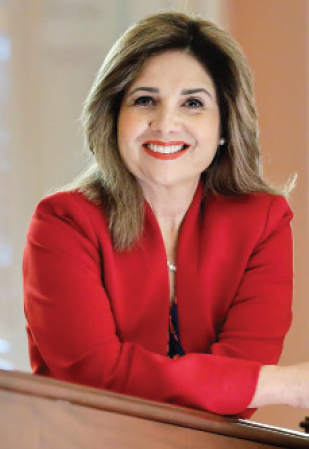
It’s a lot of turf to cover, but Sen. Alvarado-Gil manages just fine, thank you very much.
“My district is larger than 10 states in the U.S.,” boasted Alvarado-Gil, who was elected in 2022 and will be seeking her second term in Sacramento this fall. “I pride myself on being accessible, and when I go into a grocery store or the post office and people come up to me and tell me stories of the results we’re getting … those stories carry me for days.”
While she’s also proud of the fact that women now outnumber men in the state senate, she knows that politics, as a whole, is a world dominated by men.
“I don’t think that’s necessarily a disadvantage,” said Alvarado-Gil, who has a blended family of six children and two grandchildren (a third is due in March) with husband Cesar Alvarado-Gil, the chief counsel at UC Merced. “I look at it as a gift. But it also makes me a target, so I do have to work harder to navigate what has traditionally been a male profession. But I’m not the first one who’s had to do that. And that male domination has been whittled away. We just celebrated the senate’s first Latina president pro tempore (Sen. Monique Limon), and that was a big milestone for us.”
Alvarado-Gil was born in Mountain View to parents who immigrated from Mexico. She pursued a degree in animal science from UC Davis, but halted her studies to raise her children. Eventually, she obtained a bachelor’s and a master’s from the University of San Francisco. She has been open about her early struggles, which included being placed in foster care, and surviving a sexual assault. It’s those hardships that have fueled her drive as a legislator.
“I remember when I was running for office, I was told I could never have an impact on Prop. 57,” said Alvarado-Gil, referring to a measure that created a loophole where those who raped an unconscious or intoxicated person could not be prosecuted for a violent felony. Alvarado-Gil’s Senate Bill 268, signed into law by Gov. Gavin Newsom in 2024, closed that loophole. “That tells me there is an avenue to do what’s right and responsible in Sacramento,” she said. “And my colleagues have to understand this. We know what’s right; we just have to do it.”
With such a vast area to cover in District 4, its difficult for Alvarado-Gil to be as present throughout her district as other legislators. But she’s dedicated to meeting as many as she can, as often as she can.
“It’s all about the constituents,” said Alvarado-Gill. “I’m proud that constituents can give me their unfiltered feedback. I really take that to heart. They know we’re in this together.”
By Joe Cortez
Mickey Peabody
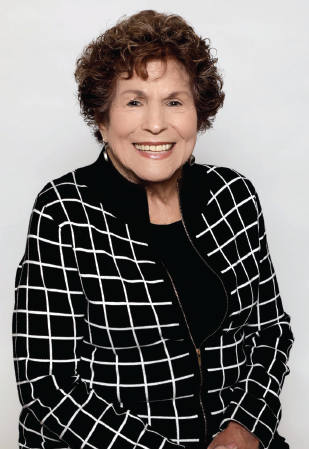
From her earliest involvement in schools her children attended to later work with the county Board of Supervisors, the Oakdale City Council and the state’s Senior Legislature, she has been helping to make a difference for decades.
Now, at 89, Peabody has slowed down some physically – heart surgery and cancer among her battles – but remains involved as much as she can, there to offer advice and guidance as a new generation takes over.
For Peabody, she found community service to be the most gratifying, and a place where she could get things done at the local level. But her work on multiple county issues, from senior transportation to mental health advocacy, also continues to have an impact.
Born and raised in Fresno, she moved with her husband and three small children to Oakdale in December of 1965.
“I’ve been political since my father ran for city council when I was like 16, I helped him with his campaign,” Peabody said. “From that moment on, I’ve been political.”
Included in her vast resumé of work is six years serving on the Oakdale City Council, helping bring the Gladys L. Lemmons Senior Community Center project in Oakdale to fruition. It is a stand-alone facility, adjacent to a senior housing complex, that is open to the community’s senior citizens and offers multiple programs and services.
She also spent four years as the field representative for longtime District 1 Stanislaus County Supervisor Pat Paul at the county level, and served more than 20 years on the Stanislaus County Mental Health Board, representing the east side of Stanislaus County. She then moved on to a position on the Area Agency on Aging Commission, with another 20 years dedicated to that panel. She was a founding member of the Stanislaus Senior Foundation and, with former longtime Modesto City Council member, the late Jenny Kenoyer, Peabody was one of the founding directors of MOVE, a transportation program that provides “door-through-door” service for the county’s senior citizens, veterans and disabled residents to get to appointments, shopping and more.
Peabody and Kenoyer were instrumental in the passage of Measure L, a half-cent tax that provided funding for critical transportation issues, including the MOVE program.
Her work with Pat Paul at the county level, Peabody added, was “the best job I ever had … and the worst.”
That, she said, “because every time you picked up the phone, somebody was mad. They didn’t call because they were glad. They had an issue … and the good part about it was you could solve those.”
Time spent as the senior Senator for Stanislaus County on the California Senior Legislature gave Peabody the opportunity to take issues to Sacramento on behalf of the region, helping to get a variety of senior needs and concerns heard at the state level.
And while her earliest involvement in the community was being a part of the parent club when her children were in school, Peabody used that as a springboard into a much larger arena.
Among her accolades through the years, Peabody has received the Outstanding Women’s Award for Stanislaus County and the Lifetime Achievement Award from the Oakdale Chamber of Commerce. She was also instrumental in forming the ‘Silver Strummers’ group of senior ukulele players, a popular musical group in the area for senior citizens that has expanded to include a harp, guitars and drums, with the seniors playing at a variety of functions in the region.
“To see something blossom,” Peabody said of what means the most to her in her various activities.
She also said she found it easier to “get things done” as a community activist as opposed to being an elected official, with more freedom to act independently as an activist, not having to go through the proper channels and red tape that government inherently brings.
“After six years (on the Oakdale city council) I realized I could do more on the other side of the podium,” she noted.
With more than 50 years of community service and government work to her credit, Peabody said she has had to “take a step back” as she has dealt with a serious bout of COVID-19, a broken neck, heart surgery and leukemia, all within the past five years.
Though passing the torch on to a new generation and excited about the possibilities for the future, she said there’s one thing that will always remain the same.
“It’s about how you use volunteers and make them feel worthwhile,” Peabody explained. “A volunteer has to be appreciated.”
She also pointed to Oakdale’s senior center as the project she is most proud of.
“It’s a commitment to taking care of our seniors,” she said.
By Marg Jackson
Britt Rios-Ellis
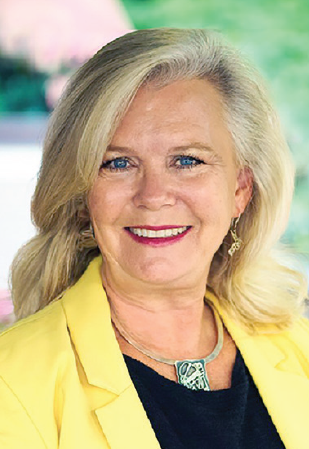
In her address at the Ed and Bertha Fitzpatrick Arena, titled 'The Pulse of Possibility and Leading with Cariño,' Rios-Ellis reflected on the University's role as more than an academic institution.
"We are a beacon where dreams flourish and opportunities abound,” she said. “Together, we are creating an environment wherein knowledge, diversity, respect and collaboration thrive, ultimately shaping a brighter future for the Valle Central."
“My vision for Stan State is one where everyone, of all backgrounds, has equitable access to the resources and opportunities they need to thrive. Cariño-laden inclusivity is the force that transforms education into equity, and equity into progress. At Stan State, cariño is demonstrated in the way we show up for one another, the way we center students in every decision and the way we embody strength and kindness as Warriors."
She described the “pulse of possibility” she felt the moment she arrived on campus — a rhythm of resilience, dreams and aspirations carried by students, faculty, staff, alumni and partners throughout the Valley.
“It is the rhythm of hard work through challenges overcome and destinations realized,” she said. “This pulse is alive in every lecture hall, every lab, every relationship and every graduate who walks across our stage. It is truly the sound of bright futures unfolding.”
Over the past year under the direction of Rios-Ellis, Stan State earned national recognition with its second consecutive five-star ranking from Money.com and being named a top university in the Central Valley for return on investment by the College Futures Foundation.
In August, the University received a $435,255 grant from BEAM Circular to transform existing facilities on the third floor of the Naraghi Hall of Science into a state-of-the-art laboratory with bioreactors, sequencing and imaging tools and plant growth chambers, establishing the Centre for Sustainable Biotechnology.
Outside of Turlock, there is rapid expansion at the Stockton Campus with a new two-story, 48,000 sq. ft. academic building equipped with classrooms, labs, offices and study spaces nearing completion. Additionally, Health Plan of San Joaquin and Mountain Valley Health Plan invested $2.5 million to double the number of healthcare providers the University trains in Stockton.
When she was appointed in 2024, Rios-Ellis served as provost and executive vice president of Academic Affairs at Oakland University in Michigan. At the time, she already had strong ties to the CSU system. After she earned a bachelor’s degree in political science and Spanish, a master’s degree in health and fitness management, and a Ph.D. in community health at the University of Oregon, Rios-Ellis served as a faculty member in the Department of Health Science at California State Long Beach from 1994 to 2014.
From 2005 to 2015, Rios-Ellis served as founding director of CSULB’s Center for Latino Community Health, Evaluation, and Leadership Training in alliance with UnidosUS. She was recognized with a CSULB Outstanding Professor Award in 2013 for her significant impact on Latino health research and education, and was named Woman of the Year by the National Hispanic Business Women’s Association in 2010 and the Regional Hispanic Chamber of Commerce in 2009. In 2008, she received the Sol Award from the Los Angeles County Office of HIV/AIDS Planning Prevention.
From 2014 to 2020, Rios-Ellis served as founding dean of the College of Health Sciences and Human Services at Monterey Bay State, where she led fundraising and strategic planning efforts and co-founded the Master of Science Physician Assistant Program — the first of its kind in the CSU.
By Christopher Correa
Susan Dell'Osso
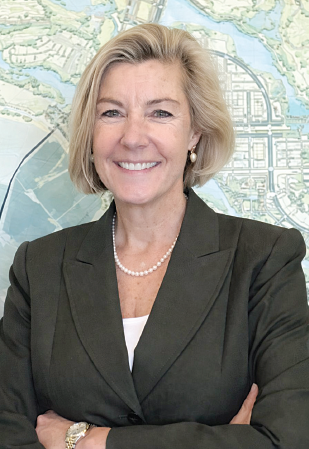
Dell’Osso is the President of River Island at Lathrop Development.
She has been overseeing the transformation of the 4,995-acre Stewart Tract near Interstate 5, the 120 Bypass, and Interstate 205 from a San Joaquin Delta island that for a century was used for row crop farming into a 15,001-home community.
“It’s so personal, I love everything about it,” Dell’Osso said of her job. “I work in the city where I live. Not many developers can say that.”
Nor can they say they are developing the largest planned community ever built in the Northern San Joaquin Valley.
It is not what the daughter of Dutch immigrants who was raised in Fullerton and earned bachelors and master’s degrees in economics from UC Santa Barbara thought she’d be doing when she accepted a job with a Big Eight accounting firm — Arthur Anderson — after graduation.
Three years later, wary of spending 30 percent of her time traveling, she accepted a job with Cambay Group.
That was 38 years ago.
She started learning the entitlement end of the development business and was assigned to the Lathrop project.
It took more than a dozen years to get River Islands to the point that dirt was being turned in 2011 and another five years before the first home was built.
To get to the point homes could be built on Stewart Tract, Dell’Osso has led a team of out-of-the-box thinkers that have done what few, if any, developers in the valley have done.
Put in place 200-year flood protection without the need for federal and state permits or financial assistance by essentially creating a parallel levee and then filling in the gap to make it 300 feet wide.
Secured permits and built the first road bridge crossing of the San Joaquin River in 50 years.
Negotiated an ecological restoration plan that includes creating a flood bypass that both the Sierra Club and state signed off on.
Established the Lathrop Irrigation District that supplies River Islands with electricity at rates below what PG&E charges.
Founded the River Islands Academies charter school system that in the past 10 years has opened a high school and three elementary schools. She also serves on the school board.
Designed and is developing the longest levee greenbelt with a paved bike path that will feature a paved 18-mile bike path that will not cross a single road.
And while doing that, 28 years ago she partnered with her husband Ron to start the Dell’Osso Farm corn maze and numerous other attractions that now brings nearly 200,000 people each October to Lathrop.
She has served on the San Joaquin Partnership board, an organization that actively seeks employers to locate in the county, for more than 20 years.
Dell Osso is a founding member of the Lathrop Rotary that was launched in 2002 and is president of the Reclamation District 17 Board.
By Dennis Wyatt