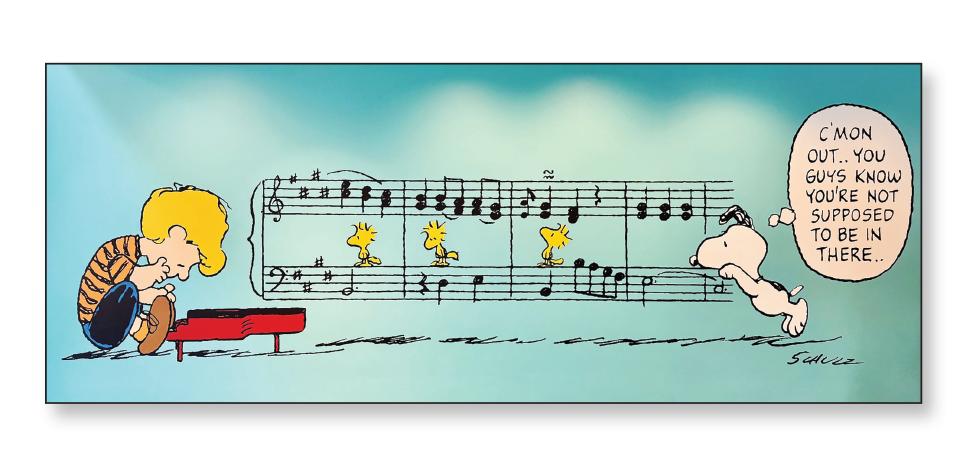
For 50 years, cartoonist Charles M. Schulz created the immortal Peanuts comic strip, sharing witticisms and insights on life and humanity through the distinct personalities of his characters Charlie Brown, Linus, Snoopy, Lucy and more. When he passed away in 2000, wife Jeannie Schulz and his many friends and colleagues were determined to keep the joy and his legacy of laughter alive, and in 2002, opened a fascinating and fun Museum in Santa Rosa, CA.
A Cartoonist from the Heart
Born in 1922 in Minneapolis, MN, Schulz knew from the start he wanted to be a cartoonist. “It was the only thing he wanted to do,” Jeannie Schulz explained. “He used to say he had no other skills, so what else would he do?” An uncle nicknamed him “Sparky” after the horse Sparkplug in the Barney Google comic strip, a name that would stick for the rest of his life.
In February, 1937, at age 14, he had his first comic sketch published in Ripley’s Believe It or Not. It was of his dog Spike, the inspiration for Snoopy. In his senior year in high school, he enrolled in a correspondence cartoon course with the Art Instruction Schools, learning essential techniques. After serving in World War II, he returned to St. Paul, MN. His first comic, Li’l Folks, appeared in 1947 in the St. Paul Pioneer Press. In 1950, he sold the comic to the United Feature Syndicate. They renamed it Peanuts, a title he never liked.
Happiness is Peanuts
There is a saying that when people find their passion, success follows. Over the next 50 years, Peanuts would become a cultural phenomenon. By 1958, the same year Schulz moved with his family to Sebastopol, CA, the comic strip appeared in 400 newspapers. When he announced his retirement in 1999, the multi-award winning strip had grown to over 2,600 newspapers worldwide, with over 100 million readers.
“He was such a genius at those four little panels,” Jeannie noted. “He could figure out how to take an experience he’d seen or overheard and distill it down. He used to say, ‘I have a repertory company (in Peanuts), and no matter what idea I get, I have a character who can play it out.’ Sparky was often asked, ‘Where do you get your ideas?’. He never bought or accepted ideas; he just created them out of his observations of people. I did contribute in that he took some of the stupid things he heard me say. I called him my Sweet Babboo, and he used it in the comic strip. Once he did that, I found that I didn’t use it anymore.”
In 1964, Schulz became the first cartoonist to earn two Reubens, the most prestigious honor awarded by the National Cartoonists Society. Peanuts was on the cover of Time Magazine in 1965, the same year the beloved animated TV feature A Charlie Brown Christmas appeared – it would later win a Peabody and an Emmy. Snoopy and Charlie Brown joined the astronauts on Apollo X in 1969. More Emmy-winning animated TV specials followed, and an entry in the Guinness Book of World Records in 1984. Schulz was posthumously awarded the highest US civilian honor possible, the Congressional Gold Medal, in 2000. A Peanuts movie came out in 2015. 2025 marked the 75th anniversary of the comic strip’s publication, an event the museum continues to celebrate with its ’75 Years of Humor’ retrospective through March 18, 2026, which will be followed by new and changing exhibitions. And today, Snoopy-themed merchandise is enjoying a surge in popularity around the world.
The Kite-Eating Tree
For lovers of Peanuts, there is no greater delight than a visit to the Charles M. Schulz Museum. “We wanted to create a welcoming place which not only preserves and displays Sparky’s cartoons and showcases his career,” Museum Director Gina said, “but also helps create an appreciation for and understanding of cartoon art and the illustrative process. We have an education center where people can try their hand a cartoons, changing exhibitions and programs, and more. Our Museum celebrates Sparky and his Peanuts family.”
At 27,000 square feet, the two-story Museum is designed for the young at heart of any age. Cushy sofas offer places to flip through fascinating scrapbooks. Displays are designed for you to get up close, to learn about different artists and cartooning techniques. One of my personal favorites was seeing his actual work studio, relocated from its original location to its own room; be sure to watch the video where you can see him talk and draw his characters simultaneously, as if he were there at work.
There are discoveries both overt and subtle. Gina pointed out the large tile mural where Lucy holds the football, awaiting Charlie Brown’s kick. Get up close, and you see it’s a collage composed of 3,588 Peanuts comic strips. The zigzag parquet floor emulates Charlie Brown’s shirt pattern. In the Great Hall, the square-cut ceiling is designed to look like the four panels of a comic strip. A magnificent wooden mural, “Morphing Snoopy”, reveals the genesis of Snoopy from real dog to dancing beagle. Outside, visitors can walk through the Snoopy Labyrinth and spot a real kite-eating tree clutching its victim in the upper branches!
There’s the nursery wall painted by Schulz for his daughter in 1951 in their Colorado home, subsequently buried by coats of paint, then rediscovered by a new owner who contacted the Museum. “She felt sure we would want this piece of history,” Gina said. “When she offered it, we grabbed it and worked it into a permanent exhibit.”
Despite hobnobbing with royalty and celebrities, Schulz never forgot his roots. When the Santa Rosa ice skating arena was forced to close in 1967, he and his first wife Joyce stepped in. After a zoning fight, the Schulzes were able to break ground on their ice arena in 1968. It took almost a year to build, opening in 1969.
“They loved skating there as a family and felt that it was an important part of the community,” explained Gina. “Once Snoopy’s Home Ice arena was built, Schulz would walk from his studio to the ice arena nearly every day for breakfast and lunch at The Warm Puppy Café inside the arena, and enjoy an English muffin or a tuna fish sandwich. People would come up to chat.”
His table is still there, with a vase of flowers, and pictures from those meetings. Just beyond the ice arena is Snoopy’s Gallery and Gift Shop, with an array of Peanuts merchandise, and a small display of vintage memorabilia upstairs.
Scattered about the Museum’s campus are larger-than-life sized statues of Charlie Brown, Woodstock, Snoopy and more, perfect for photo ops. And all this is just for starters. A visit to the Museum can be an all-day affair, with ongoing events and exhibitions, special programs and more.
When the world shut down in March 2020, Gina and her team had to pivot fast when the Museum closed. They successfully transitioned the Museum to virtual programming and a curriculum by planning two weeks at a time, so as to be flexible and adapt activities as needed. Today, recordings of in-person talks by renowned artists, authors, and other special guests, and intimate virtual tours of current exhibitions are offered exclusively to Museum members, enabling access to the Museum’s programs and exhibitions, regardless of location.
So, here’s your chance to discover everything you ever wanted to know – and more – about the characters and their “creator,” Charles M. Schulz. I guarantee you will enjoy this legacy of laughter, lovingly preserved by Jeannie, overseen by Gina and the dedicated Museum staff and volunteers. For more information on all there is to do and see at the Charles M. Schulz Museum, visit schulzmuseum.org.