
Traipsing around Valley Forge Historical National Park in Pennsylvania on a hot humid summer day couldn’t have been more different from what the fledgling army of the Revolutionary war experienced during the frigid winter of 1777-78. Yet it was in this hilly farmland where what would become the victorious Continental Army under the command of George Washington was forged.
History, Clarified
Back then, when winter struck, enemy armies traditionally hunkered down in winter encampments, keeping an eye on each other, but not much else. Valley Forge was such an encampment; no battles occurred.
The fledgling army was in deep trouble. Plagued by inadequate food, clothing and equipment since the war began, and operating as a fragmented coalition of state militias with different fighting styles, the army’s future was in doubt. It would take all Washington’s strength and determination – and one Prussian – to create the crucible in which the soldiers and the army would be reforged.
Farmland Overrun
Washington and his officers were housed in a local farmhouse, owned by David Potts, close to the village of Valley Forge. In the five months they were encamped, he focused on persuading Congress to reform the supply system to end the army’s brutal shortages, and on attracting more experienced officers to lead the militias.
Prussian officer Baron von Steuben was given the job of training the troops. He taught the soldiers new military skills and how to fight as a unified army. These reforms in fighting tactics, along with changes to military hygiene and army organization are considered to be the foundation of the modern US Army.
In May, Washington learned that the long-sought Alliance with France had been arranged, one that would infuse the campaign for independence with new resources and soldiers. The British evacuated Philadelphia, pursued shortly thereafter in June by Washington and his Continental Army. While the Revolutionary War would last five more years, Valley Forge was a key turning point.
Reconstructing the Past
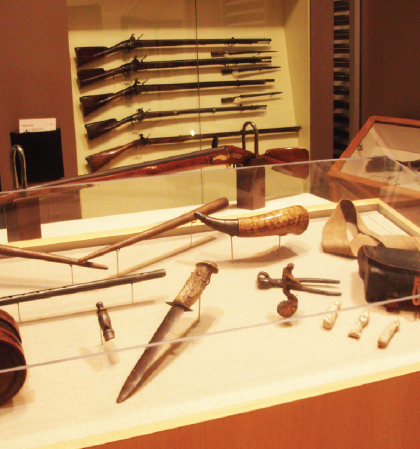
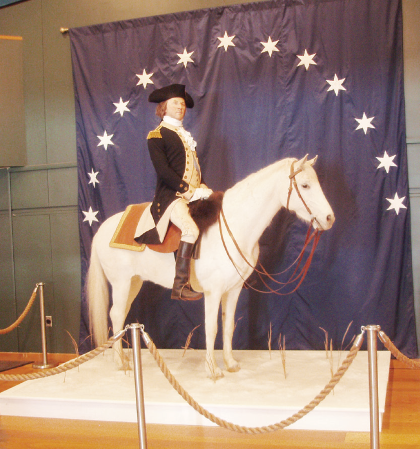
Today, history has been reconstructed. The best place to start is at the park’s Visitor Center. Fascinating archival displays show the soldiers’ lives, and an informative movie reveals intriguing insights. The park is best seen via the 10-mile automobile Encampment Trail. Although there are 35 miles of trails, the destination points are so spaced that I can attest it’s challenging to try and reach them all by foot. A seasonal trolley tour is available, as well as ranger tours; you can even rent bicycles.
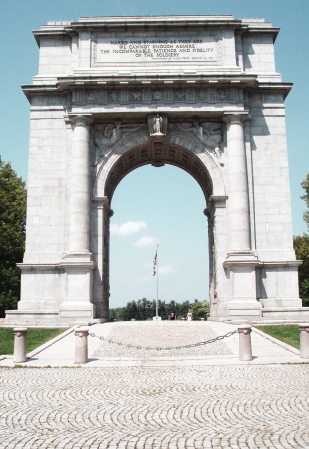
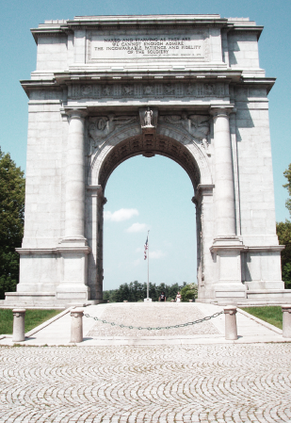
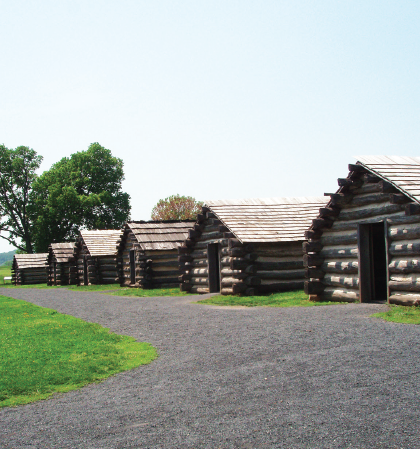
Along the trails, there are clusters of old wooden cabins in which you can view how the soldiers were stacked like wood on bunk beds three high, squeezed beside a tiny fireplace. Redoubts – earthwork defenses – bristle with sharp pikes and cannons that peer out toward distant Philadelphia. Stone monuments stand guard, presenting the different militias’ home states. A sculpted 1917 National Memorial Arch overlooks the grassy parade field where thousands once marched. Washington’s headquarters are tucked alongside the Schuylkill River.
Standing there among wind-stroked sighing grasses and trilling blackbirds, gazing down-valley, one tries to imagine the shouts and tramp of drilling soldiers, the reek of unwashed bodies, the odor of open-air fires, the loneliness of men far from families and home. Yet they all endured to become a part of a critical point in history where our nation’s future and democracy would be forged.
In celebration of our nation’s 250th birthday in 2026, the park will feature a variety of a period of celebrations and commemorations; it also marks their 50th birthday as a national park, which will also be celebrated with events and activities (nps.gov/vafo/planyourvisit/index.htm). ●