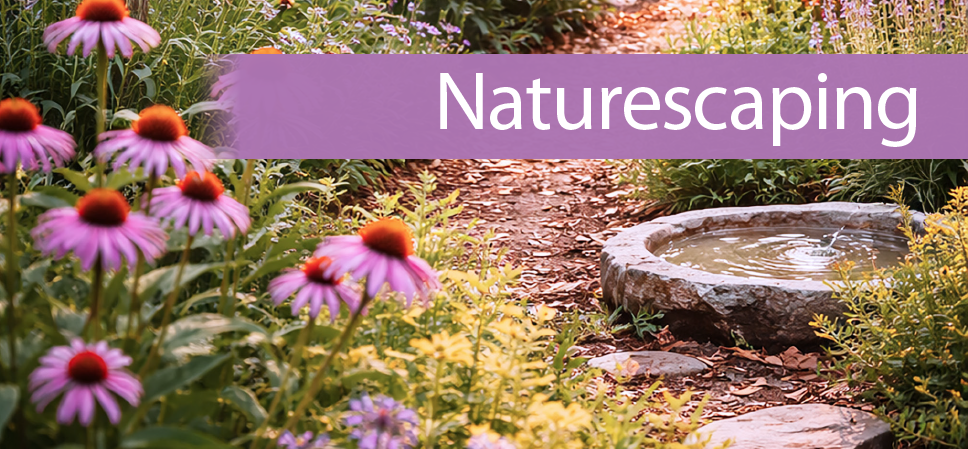
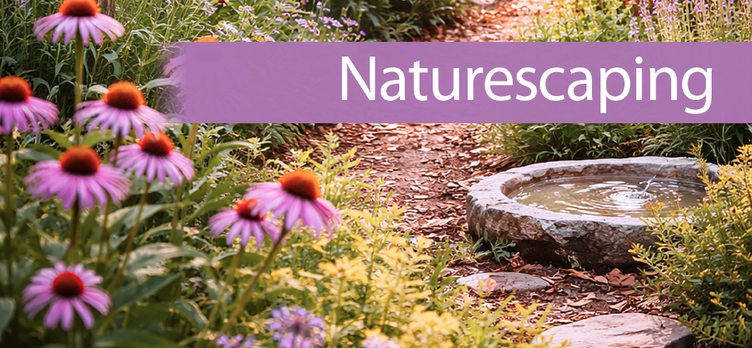
Imagine a garden designed to focus on creating natural wildlife habitat. Why not eliminate turf grass from your own garden and replace it with trees, shrubs, perennials, and annuals that benefit wildlife?
Welcome to Naturescaping, a method of landscaping that allows people and nature to coexist. By growing appropriate plants, especially natives, and adopting a few new practices, you can attract insects, birds, and other wildlife to your garden. Naturescaping can help to replace habitat destroyed by urban development, while at the same time helping your garden fit better into the local environment. If neighbors cooperate to transform their gardens, together they can create wildlife corridors between disconnected natural areas. If you’d like to try this, here are some suggestions for naturescaping your own garden.
Reduce or eliminate your lawn.
Lawns can provide an attractive surface where people and pets can play or just relax. But lawns consume a lot of resources, including large quantities of water for irrigation, as well as the energy needed to manufacture fertilizer and herbicides and to power lawnmowers. At the same time, lawns contribute little of value to wildlife.
Reduce or eliminate pesticide use.
Because pesticides often kill beneficial insects along with the unwanted ones, they should be used very sparingly as a last resort.
Add native plants to the garden.
Insects coevolved with native plants, and those plants provide good quality food for them. Non-native plants don’t always contribute the same value to local wildlife. Native plants are also adapted to our local soils and climate.
An example of native plants used to create attractive landscape element while providing habitat for wildlife. Cindy Weiner
Be a little lazy and a little messy.
Don’t be too quick to deadhead spent flowers, cut plants back, rake leaves, weed, or prune dead branches. If you allow at least some flowers to go to seed, those seeds will provide food for birds.
Create vertical habitat layers.
Incorporate a variety of plant heights in your garden. Different critters will use different areas of a layered garden.
California Pipevine ( Dutchman’s Pipe) is the host plant for the pipevine swallowtail butterfly. J. Alosi
Provide the critters in your garden with food, water, shelter, and a place to raise their young.
While many pollinating insects are generalists in that they collect pollen and sip nectar from a variety of plants, some are specialists and forage at only one or a few plant species. Some butterflies and moths lay their eggs on specific host plants.
Other resources:
The Xerces Society has a list of California pollinator plants at: xerces.org/publications/plant-lists/recommended-plants-california-central-valley-region
The California Native Plant Society maintains Calscape, a database of native plants in cultivation along with their cultural requirements and pollinator associations.