We’ve all heard how the Wright Brothers successfully achieved the first manned, heavier-than-air powered flight on December 17, 1903 at Kitty Hawk. But not until I visited the Wright Brothers National Memorial in Outer Banks, North Carolina, did I discover how much more there is to the story that we never hear about– the passion, the inspiration, the flights and the failures… and the whimsical child’s toy that fueled a dream to fly.
‘Bat’ Flight
Wilbur (born 1867) and Orville (born 1871) were two of seven siblings. The close-knit family lived in Dayton, Ohio, and shared a love of learning and science. In 1878, their father brought in a curious toy that would inspire their future.
Without letting them see what it was, he suddenly tossed it into the air. Instead of falling, it flew across the room, fluttered about, and then slowly sank to the floor: a simple wind-up toy with a propeller powered by a rubber band. Known as a ‘helicoptere’, the mesmerized boys dubbed it ‘the bat’, and played with it until it broke.
Building Blocks of Flight
Many great minds were already experimenting with flight well before the Wright Brothers. George Cayley (1773-1857) is considered the father of aerodynamics. Alphonse Penaud (1850-80) built a rubber-band powered model that flew 131 feet, considered the first stable aircraft. Octave Chanute (1832-1910) shared collected aeronautical knowledge; he encouraged the Wrights, who used his biplane glider design. A famous German experimenter, Otto Lilienthal (1848-96), was the first true glider pilot to achieve multiple extended glides, before dying in a flight crash.
Crediting their mechanical ingenuity as coming from their mother, and having taught themselves bicycle repair, in 1892 the Wrights opened a repair shop in Dayton. Later, funds from their successful business would help propel their flight experiments. Fascinated by the adaptive flight of turkey vultures as well as others pursuing controlled flight, and believing they had as good a chance at success as anyone, they decided to focus on aeronautics and human flight in 1899.
Kitty Hawk Myth
Gliders served as the foundation of flight. And to operate a glider, regular and consistent breezes were needed. With the help of the US Weather Bureau, the brothers set up a temporary camp in Kill Devil Hills in Outer Banks, North Carolina – and it was here that the first successful flight occurred.
In 1900, the Outer Banks were empty shifting sand dunes, without vegetation and with a much-needed steady wind. Kitty Hawk, four miles away, was the only tiny settlement. The Wrights would spend the next three years commuting between Dayton and their two shacks near a huge sand dune, Big Kill Devil Hill. Between 1900 and 1902, they conducted over 1,000 test glider flights, setting a world record. By 1902, they had added a rudder for steering, but control and lift problems persisted. Back home, frustrated by their failures and near to quitting, they instead decided to build their own wind-tunnel, enabling them to test different shapes and curves for wings.
In 1903, they began to experiment with propellers (just like “the Bat”), and are credited with the first effective airplane propellers, considered one of their most original and purely scientific achievements. The new flyer’s wooden frame wings were covered in a strong tightly woven white cotton muslin cloth. A first-of-its-kind aluminum block water-cooled vertical 12 horsepower gas engine was designed for their flyer.
On a Cold December Day…
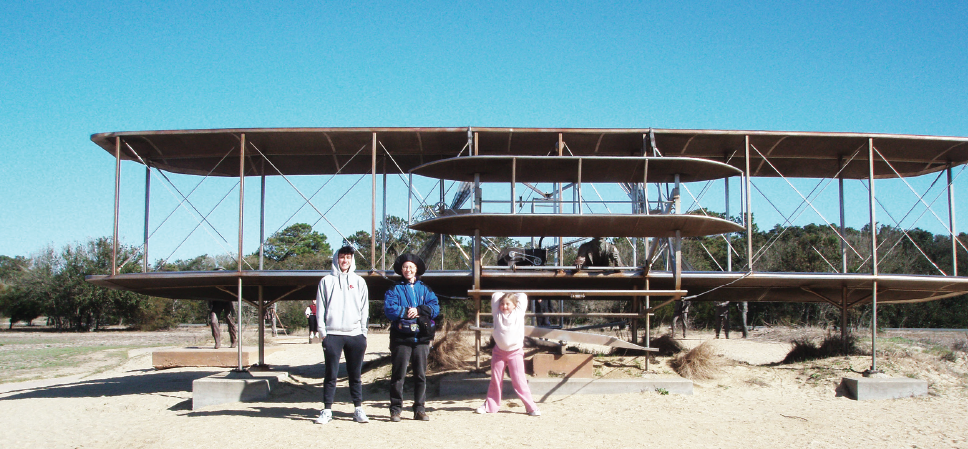
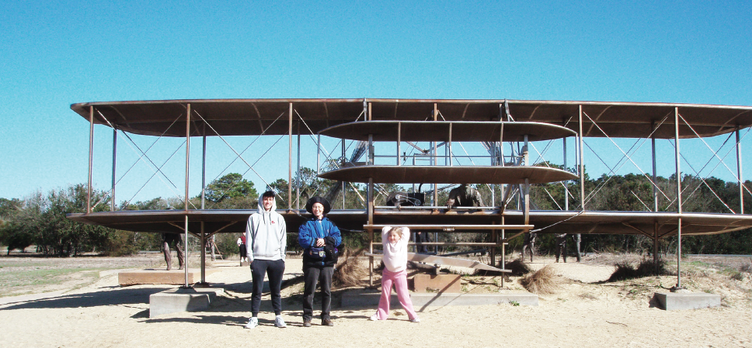
The flyer had been set up to launch off a monorail embedded in the sand to ensure a level and stable footing; it held the flyer in place with a restraining wire. On Monday, December 14th, 1903, Wilbur and Orville flipped a coin – they had agreed to take turns testing that day their new 40-foot, 605-pound flyer with its double tail and double propellers. Wilbur won. He launched and crashed into the sand. Repairs were needed.
On a wintry Thursday, Dec. 17, the brothers dressed in suits and ties. They knew it might be their last chance of the season. The roar of the motor prevented any talk, so they shook hands; it was Orville’s turn. He lay down across the middle of the bottom wing at the full-body controls. The stick moved the horizontal elevator to control climb and descent. His hips moved the cradle to warp (flex) the wings and swing the tail, the combination of which turned the flyer. A lever controlled gas flow and the airspeed recorder.
The wind speed was a feisty 27mph. Witnesses and a photographer stood at the ready. At 10:35AM, Orville released the restraining wire, flying 12 seconds, covering 120 feet. At 11:00AM, Wilbur made the second flight, 175 feet in 12 seconds. At 11:40AM, Orville made the third, 200 feet in 15 seconds. The final flight was made by Wilbur, covering a distance of 852 feet in 59 seconds. These were the first manned heavier-than-air powered flights, all 12-14 feet above the ground.
The glass plate photograph, taken by John T. Daniels, was not developed until they return to Dayton – it captured the very first moments of powered flight – moments that were nicknamed the “Miracle Moment” that forever changed the world.
Aftermath
As the docent concluded the story in the Memorial’s historic Mission 66 Visitor Center & Museum where a full-scale replica of the 1903 flyer sits inside a beautifully lit atrium, I asked him what had happened to it. Ironically, at the end of the final flight, it was struck by a gust of wind, flipping it over and over and destroying it beyond repair. He said that, instead of being upset, the brothers and the participants that day laughed, went and pulled out pieces of debris, autographed them and gave them to each other in celebration of the accomplishments.
In 1928, 25 years later, the construction of a massive 60-foot high memorial obelisk was approved in by President Calvin Coolidge 1927 to commemorate the achievement on Big Kill Devil Hill. But there was a problem. Due to the steady winds, the region’s sand dunes constantly migrate – they are actually known as living sand dunes. And between 1903 and 1925, the massive hill had moved 450 feet. Extensive work using vegetation was done to stabilize it.
In 1931 construction began; it was dedicated in November 1932, as “a testament to the questing nature of the human spirit.” Only Orville was alive to see the finished monument – Wilbur died of typhoid fever in 1912.
The monument consists of 1,200 tons of North Carolina granite standing atop a star-shaped pedestal on the 90-foot hill. Pathways encircle the monument inviting visitors to walk up and see the busts of Wilbur and Orville, gaze over the field of flight, and read inspiring quotes engraved in the stones. There are other features including ornate doors inside the tower, and on the south side below the hill, a life-size bronze sculpture recreating the Miracle Moment – where visitors can take their own ‘first flight’ with the Wright Brothers www.nps.gov/wrbr/index.htm.
Mission 66
Replete with educational and interactive exhibits, as well as ranger-led tours, the Memorial’s historic Museum is a must-see. Why is the Center a historic landmark? The National Park Service initiated ‘Mission 66’ in 1956 with a goal was to build much-needed park facilities across the nation’s park system to serve the growing demands of post-war travel. As the 50th anniversary of powered flight grew near, the National Memorial was chosen as one of the sites at which a state-of-the-art modernist visitor center was to be built.
Budget time to read the exhibits – it’s well worth it. There’s a replica of the wind tunnel, a glass case with “the Bat”, the tools they used, and details on the challenges they faced – and how they overcame them. The family story and the challenges faced over 100 years ago are inspirational. www.nps.gov/wrbr/learn/historyculture/historic-mission-66-visitor-center-and-museum.htm.
Outside the Museum, a short walk away, you can check out the reconstructed 1903 Hanger and Workshop, where the brothers lived during their tests, and marvel at the sparse accommodations. Then, a few steps further west, there is a very special place – the First Flight Boulder. It marks the lift-off point for each flight. Look north and you will see Flight Markers – each designating the landing spot of the first four manned flights.
Walk the flight trail and pause at each marker to read the inscription. Turn around and look at the Memorial reaching for the sky. Listen to the soft hiss of the ever-drifting sand in the constant breeze. You are walking among the courageous first steps of flight.